Getting Started
Pairk is a Python package designed to quantify the per-residue conservation of short linear motifs (SLiMs) in disordered regions, where traditional multiple sequence alignments (MSAs) are often unreliable. It takes a sequence of interest (the query), a set of homologous sequences, and a length of sequence fragments to analyze (k) as inputs. PairK then generates “pseudo MSAs” for all fragments in the query sequence by gapless pairwise alignment. It then calculatees relative conservation scores for each residue in each query fragment from the pseudo MSAs.
PairK is founded on the idea that disordered sequences are generally unconserved (on a sequence level) but contain short, positionally conserved fragments that are important for function (SLiMs). Global alignments of disordered sequences tend to misalign these conserved fragments. PairK is designed to focus on the per-position conservation of fragments within a sequence, rather than the entire sequence, to better capture the conservation of these motifs.
See our manuscript for more details on the method: PairK: Pairwise k-mer alignment for quantifying protein motif conservation in disordered regions
to install
pip install pairk
or for an editable install that you can modify:
git clone https://github.com/jacksonh1/pairk.git
cd pairk
pip install -e .
Pairk Overview
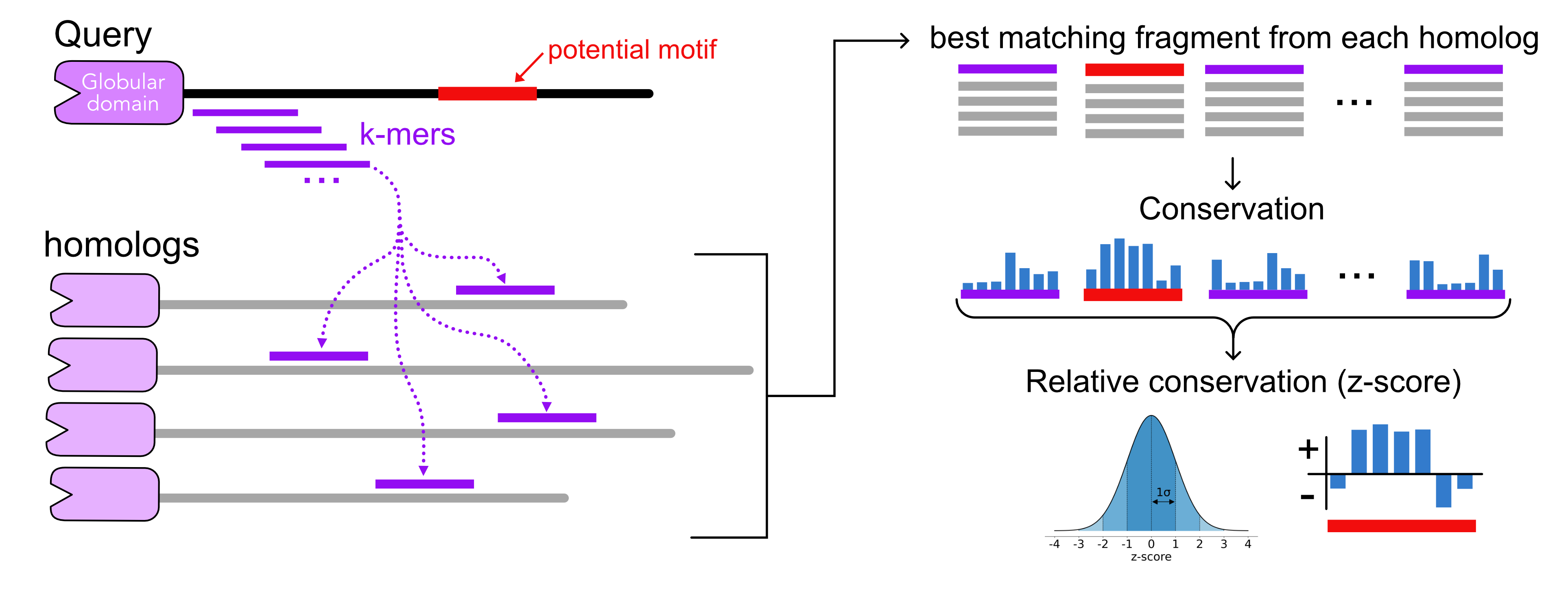
The pairk pipeline:
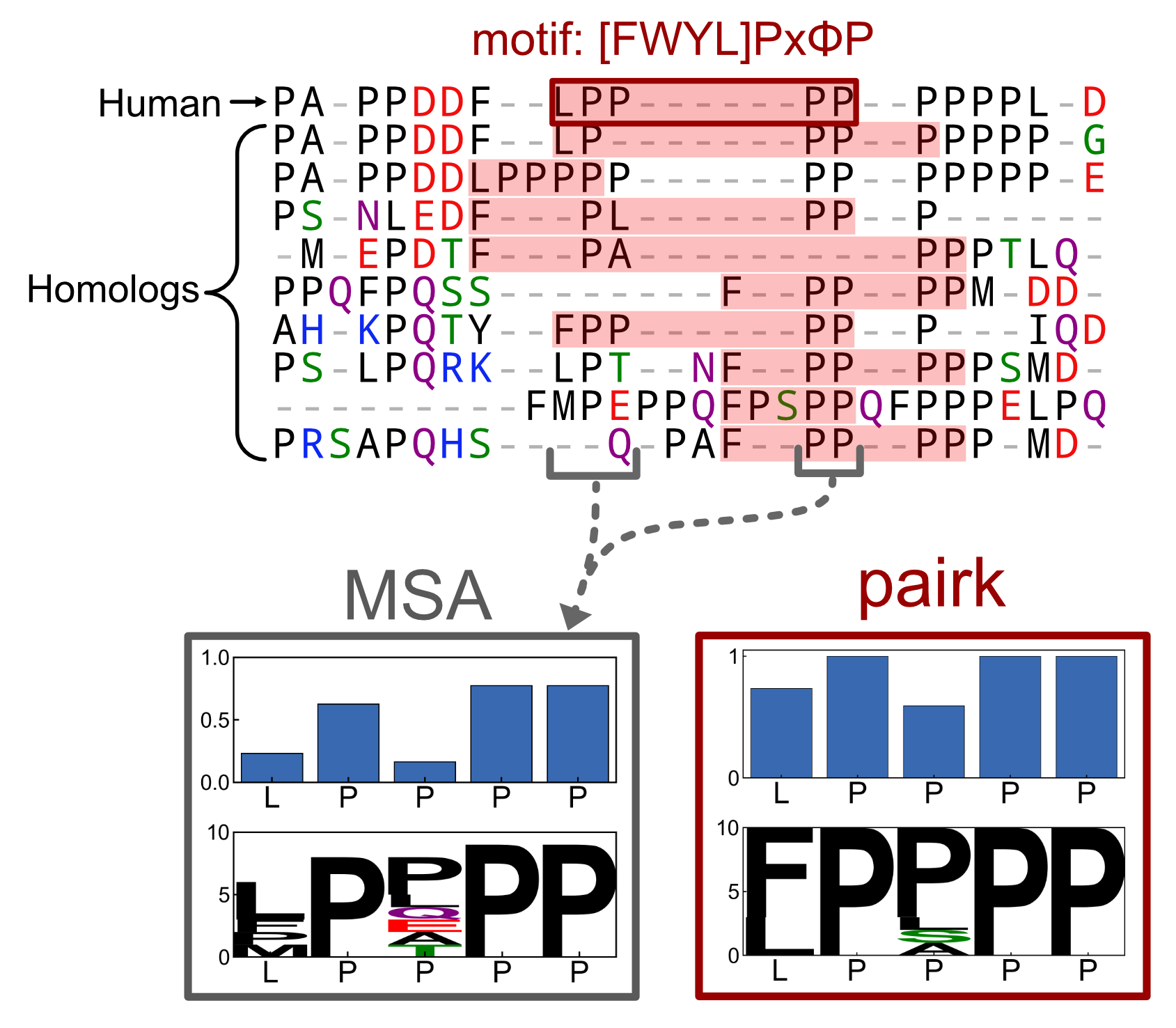
SLiM conservation from an MSA vs. pairk:
The pairk pipeline is composed of two main steps:
1: Pairwise k-mer alignment
For each k-mer in the query IDR, step 1 finds the best scoring length k fragment from each homolog IDR in a gapless and pairkwise manner. The position, sequence, and score of the best scoring fragments are stored in the results.
in informal pseudocode, the algorithm looks like this:
for each k-mer at each position in the query IDR:
    for each homologous IDR:
        for each k-mer at each position in the homologous IDR:
            score the alignment of the homolog k-mer - query k-mer match (with no gaps)
        store the score, position, and sequence of the best scoring homologous k-mer
    construct a "pseudo-MSA" composed of the query k-mer and the best scoring k-mers from each homologous IDR
2: k-mer conservation
For each k-mer “pseudo-MSA” from step 1, step 2 calculates the conservation of each position in the pseudo-MSA using a column-wise scoring function. The scores are then converted to z-scores to give the conservation relative to other residues in the query IDR. The z-score background distribution is all of the column-wise scores from all of the pseudo-MSAs.
for each k-mer in the query IDR:
    for each position in the pseudo-MSA:
        score the conservation of the position using a column-wise scoring function
Convert all scores for all k-mer pseudo-MSAs to z-scores
quickstart
Here’s a quick example to get you started:
import pairk

# Load example dataset
ex1 = pairk.example1

# Perform k-mer alignment
aln_results = pairk.pairk_alignment(idr_dict=ex1.idr_dict, query_id=ex1.query_id, k=5, matrix_name="EDSSMat50")
The resulting pseudo-MSAs are stored in the aln_results object (an instance of the pairk.PairkAln class). You can access the results from this object’s attributes directly (i.e. the pairk.PairkAln.orthokmer_matrix, pairk.PairkAln.position_matrix, and pairk.PairkAln.score_matrix DataFrames).
Let’s say that we are interested in the k-mer “LPPPP” which starts at position 75 in the query sequence. We can access the “pseudo-MSA” for this k-mer from the pairk.PairkConservation.orthokmer_matrix DataFrame or using the pairk.PairkConservation.get_pseudo_alignment() method:
In [4]: print(aln_results.get_pseudo_alignment(75))
['LPPPP', 'LPPPP', 'LPPPP', 'LPPPP', 'PPMPP', 'LPPPP', 'LPDRP', 'APSPP', 'LPPPP', 'LPPPP', 'LPPPP', 'LPPPP', 'LPPPP', 'LPPPP', 'LPPPP', 'LPPPP', 'LPPPP', 'LPPPP', 'LPPPP', 'LPPPP', 'LPPPP', 'LPPPP', 'IPPPP']

In [5]: print(aln_results.orthokmer_matrix.loc[75])
query_kmer          LPPPP
9793_0:005123       LPPPP
1706337_0:000fc7    LPPPP
51337_0:001b5a      LPPPP
9568_0:004ae1       PPMPP
43346_0:004190      LPPPP
885580_0:00488c     LPDRP
10181_0:00305d      APSPP
1415580_0:000900    LPPPP
61221_0:00105a      LPPPP
7897_0:0033c5       LPPPP
8407_0:002bff       LPPPP
173247_0:004550     LPPPP
30732_0:0046dd      LPPPP
241271_0:0048e4     LPPPP
8103_0:0045e4       LPPPP
56723_0:00152f      LPPPP
210632_0:004c0c     LPPPP
31033_0:00264e      LPPPP
63155_0:004c86      LPPPP
7994_0:004d71       LPPPP
109280_0:00369f     LPPPP
150288_0:004e5a     IPPPP
Name: 75, dtype: object
To calculate pairk conservation, an instance of the pairk.PairkAln object is used as input to the pairk.calculate_conservation() function.
# Calculate conservation
conservation_results = pairk.calculate_conservation(aln_results)
The conservation results are stored in conservation_results (an instance of the pairk.PairkConservation class). You can access the results from this object’s attributes (e.g. the pairk.PairkConservation.orthokmer_arr, pairk.PairkConservation.score_arr, and pairk.PairkConservation.z_score_arr arrays)
The pairk.PairkConservation object also contains some plotting functions. for example, pairk.PairkConservation.plot_conservation_mosaic():
# Plot conservation scores
conservation_results.plot_conservation_mosaic(position=75) # start position of the query k-mer of interest
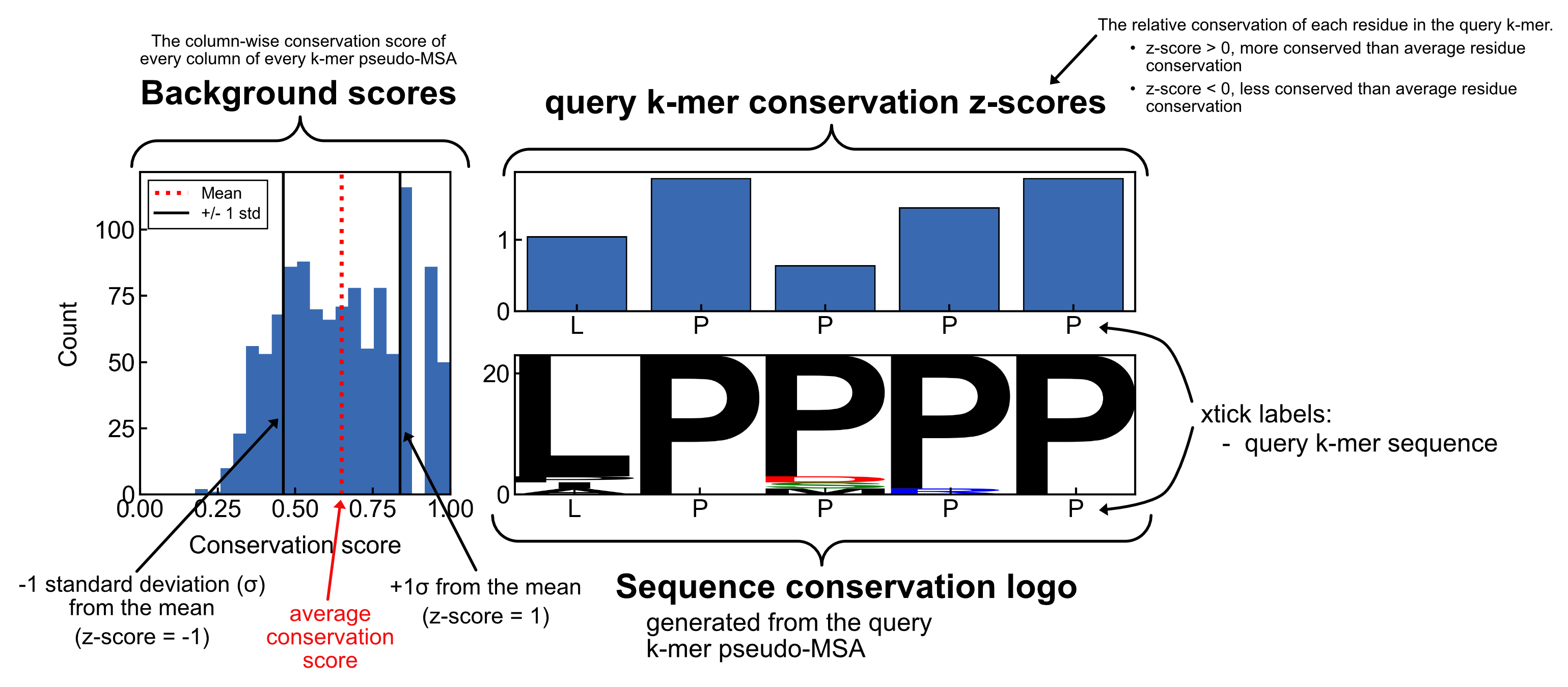
The above example output of the pairk.PairkConservation.plot_conservation_mosaic() is annotated with explanation of each element of the plot
The pairk.PairkConservation also has methods to write the results to a file or read the results from a file:
# save the results
conservation_results.write_to_file('example1_results.npz')

# read the results
conservation_results = pairk.PairkConservation.read_results_from_file('example1_results.npz')
PairK’s main functions and classes
step 1, pairwise k-mer alignment functions
pairk.pairk_alignment()- uses a scoring matrix to align the k-mers to each homologpairk.pairk_alignment_needleman()- uses a scoring matrix to align the k-mers to each homolog (use pairk.make_aligner to create the aligner object before using this function)pairk.pairk_alignment_embedding_distance()- uses embeddings from ESM2 (or user provided embeddings) to align the k-mers to each homolog. To use ESM2, usepairk.ESM_Model()to load the model before using this function (provided as themodargument)pairk.PairkAln- pairkwise k-mer alignment results are returned as an instance of this class. See the associated methods for more details on how to interact with the results.
step 2, k-mer conservation functions
pairk.calculate_conservation()- calculates the conservation of the k-mers from a pairk.PairkAln objectpairk.PairkConservation- conservation results are returned as an instance of this class. See the associated methods for more details on how to interact with the results.
utility functions
pairk.print_available_matrices()- prints the available scoring matricespairk.FastaImporter- class to import fasta files and return the sequences in different formats
See our tutorial notebook for a notebook-based tutorial on how to use pairk.
See the API documentation for more details on the functions and classes in pairk.